Language Gauge: Pictograms’ Pixelation, Aleph to Bit
The unreal thing no animal can do.

Never Meta Message I Didn’t Like
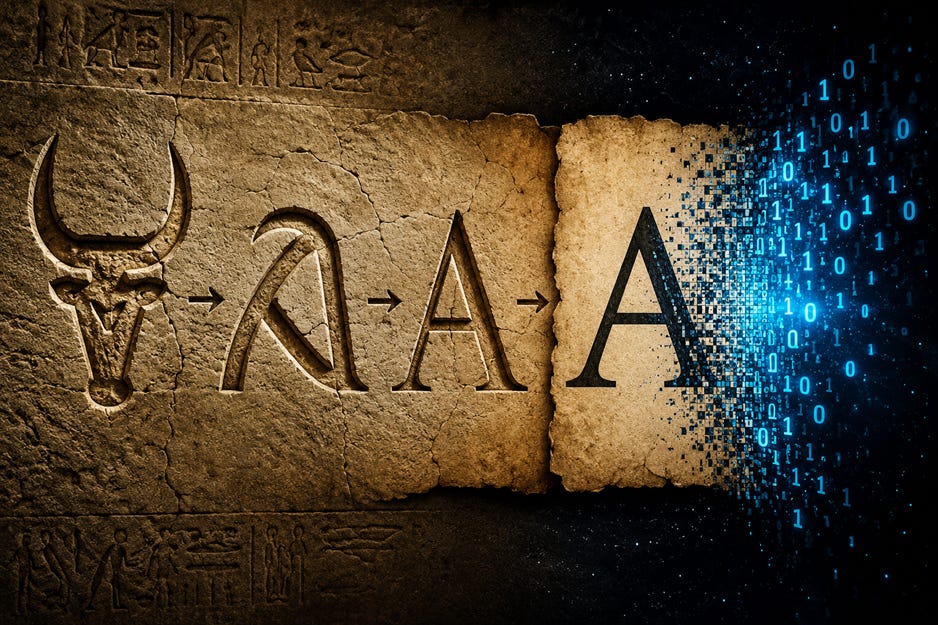
Communication is everywhere in nature, but it is welded to the present: a signal for a thing that is here, now. What humans add is meta-messaging, the power to use a small fixed set of symbols to model what is absent, past, future, hypothetical, or wholly invented, and to plant that model in another mind. A finite alphabet yields infinite worlds; pictograms (and birdsong) stay closer to one-sign=one-thing, which is why even Chinese (pictograms) drifted toward sound(s) and why the abstract letter-format let writing scale – and communication flourish. That same capacity has built everything that cannot be touched: the coordinated hunt; the hero who outlives life; money; gods; nations; commerce; wealth; growth; and dreams.
I recently had the great good fortune to hear Jonathan Leaf discuss his fascinating new book The Primate Myth (discussed here, by Nicholas Wade). A separate, post-lecture conversation drifted from his “New Theory of Human Nature” towards other man vs. animal questions:
• If a chimpanzee can press symbols on a board; if a dog can learn that “walk” and “car” and “treat” carry consequences; and if dolphins appear to trade signals beneath the surface – are human beings really so different?
• Is our language merely a more elaborate version of equipment already distributed across the animal kingdom?
My answers, respectively, are “yes” and “no”. Animals, no doubt, communicate: A bird announces a hawk; a wolf advertises its rank; a chimpanzee gestures toward food, toward danger, toward a rival or a mate; however, almost all such sounds or gesticulations remain tethered to the present moment: e.g. the affective equivalent of “there is a thing happening!” (threat, appetite, or social cue).
Human beings, of course, can do that (look at the crowds at the NBA finals); however, they have the additional, both canny and uncanny, ability to perform what I will call here “meta-messaging”: communication that sublimates or supersedes the present. The human sentence can say
• that there was a thing,
• that there will be a thing,
• that there might be a thing, and even
• that there is a thing I have invented outright, a thing that exists nowhere but in the space your attention and mine now share.
The human’s message can point at a model of the world, and can coax a second mind into that model to act as though its contents were real. That capacity is the line that separates us from them.
Birdsong Rendered in Ink
Consider the keyboard under my hands and what you’re reading (although I Dragon-dictate, rather than type): these twenty-six letters; ten digits; and a scattering of marks matter. They produce novels, constitutions, contracts, proofs, slanders, jokes, hymns, and love letters. The symbols carry almost no meaning in themselves (aside from “ABC, as easy as 1-2-3”; and in physics, or labeling coronavirus subtypes); their power lies entirely in the combination, so that a tiny inventory of parts yields an effectively unlimited inventory of ideas.
Written Chinese began as pictures: one stroke for the sun, another for the moon, one for a tree – and as such wedded and welded to its “thing”. In that bond, it sits closer to the sparrows (who awoke me this morning) than to the (axiomatically-named, “alpha”-“beta”) alphabet. Birds’ song, however intricate, is a fixed pattern for a fixed situation; necessarily so as “telecommunication”, understood by ear alone, with none of the facial cues we take for granted. The pure pictogram is birdsong rendered in ink.
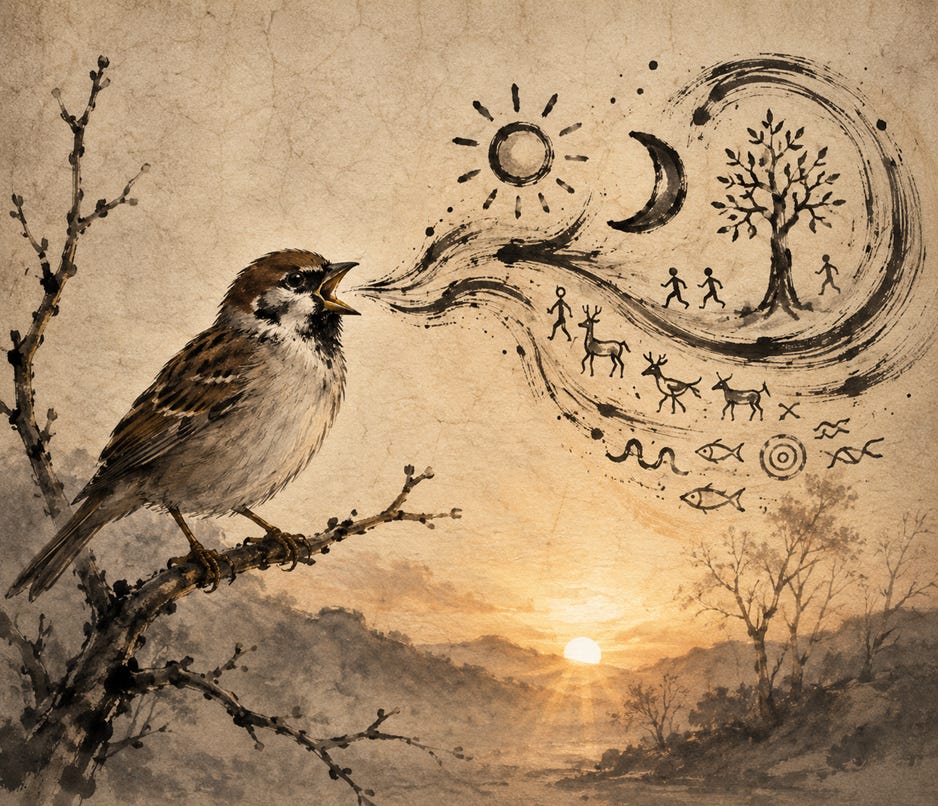
None of these choices of transcription was foresight, per se. One assumes that every such attempt was akin to any blind man’s figuring out a hotel room. For their particular forays, proto-Chinese and ancient Egyptians miniaturized and multiplied versions of earlier human expression, such as seen in places like Lascaux cave art; whereas, roughly four thousand years ago, Semitic groups such as Hebrews and Phoenicians mutated the Egyptian hieroglyphs into letters which the Greeks and the Romans adapted and continued (as we have to this day).
Neither path was wiser than the other contemporaneously; however, at wholesale ultimately, the pictures cannot carry a modern language: in Chinese, the characters have drifted toward sound; pure pictographs are now a remnant, a few percent of those in daily use, while some eighty percent are phono-semantic compounds, signs that smuggle a hint of pronunciation in beside the picture. The glyph still looks “Chinese”, but it has begun doing the alphabet’s work in disguise.
The pictogram was never built for meta-messaging. It is the cave wall, beautiful and faithful and mute about everything not in front of it. For China, the telegraph forced those characters into numbered codes; the keyboard continued that trend – until today a Chinese sentence is most often typed by spelling its sounds in (our) Roman letters and choosing the character those letters recall, barring the old and borrowing ours.
Of course, any Chinese speaker (no less than any other language’s) builds a finite stock of sounds into sentences never spoken before. The alphabet (rather than the pictogram) became the lever that let writing scale.
All Rapt Up And Nowhere To Go
Human language’s wonder is not that it labels the world; its wonder is that it manufactures worlds – as only humans can. Permit me a demonstration, the very one that I used that evening (to an initially shocked, rapt audience):
Walking here, 100 yards from my hotel, 5:30 PM (just as the rain had ended), I passed a woman wrapped in a red blanket, lying on the sidewalk. Several strangers knelt to revive her, then recoiled as if from a terrible odor and left her where she lay. Seconds later, she made a short, staccato gasp – and not a moment later, she convulsed into tight flexion, and died.
PS: none of that happened. I invented every word of it, the blanket, the strangers, and the recoil alike.
Yet the sentences had scarcely formed before each reader built the scene for himself. One pictures a particular city, another a particular doorway; one fixes on the cruelty of the strangers, another on the cause of death, another on the question of why a physician would trouble to fabricate such a thing. Every reader has just visited a place that does not exist, and has felt something real upon arriving there.
The words produced an event unmoored from reality, and the event in turn produced emotion, judgment, suspicion, perhaps the impulse to act. Nothing in the external world answered to any of it, for the episode lived, in its entirety, inside the cerebral skills and skulls of the people hearing it.
Elephant Memories
The central fact of our species is that we speak of the absent, the future, the merely possible, the frankly impossible. We speak of gods, nations, justice, currency, rights, hypotheses, and characters who were never born. Whole civilizations rest upon things that cannot be weighed, touched, or photographed.
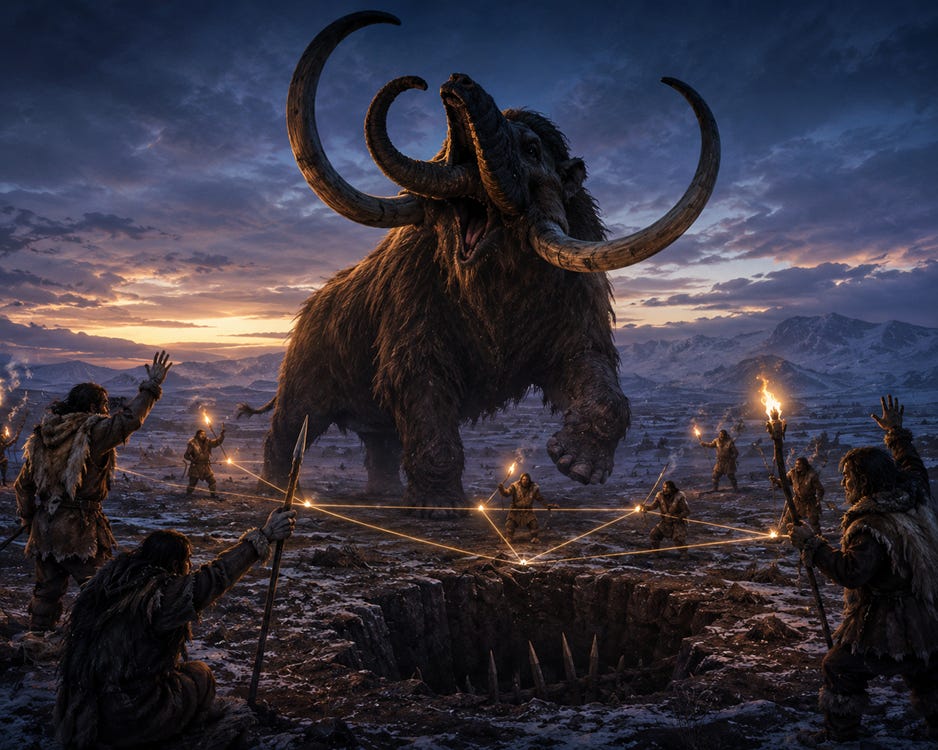
No animal is known to approach this; none convene to debate the hypothetical. The difference is not the size of the vocabulary but the reach of the imagination: our languages pour forth imagined realities and then make the imagined real. Consider the hunters who set out after a mastodon a hundred times their weight. Armored in hide and tusks, it was invulnerable to any one man. The kill demanded coordination (and presumably language) at every stage: the feint that turned the herd, the lure, the decoy, the ambush sprung on a signal, the roles assigned and rehearsed. It also demanded heroes, potentially someone to stand in the tusks’ path on the signal.
Cultivating the Culture
The hero is the first thing a group invents that outlives its use, becoming a template to which the young are molded. Scaled and compounded across generations, that is culture. So we keep the dead, the mythologized, and the famous on hand. The “reality” per se doesn’t matter: it could be Odysseus or George Washington idealized and idolized; more recently both Capt. Kirk and Charlie Kirk; on the other side of the ledger, Stalin and Voldemort.
Thus symbolized, the dead steer the accounts of the living; just as Lascaux’s living counted the dead steer: same principle, generals; saints; and (even) monsters lodge as permanent residents of our shared interior landscape. Money, whether banknote, share, or patent is worth only what collective belief assigns it. The story it carries is everything.
The Prints of Whales
The same instinct explains why we overrate the minds of other animals: we are narrators by constitution, projecting motive onto anything that holds still long enough. Nowhere is the habit plainer than with dolphins and whales, whose reputation for genius rests more on our affection than on their accomplishments.
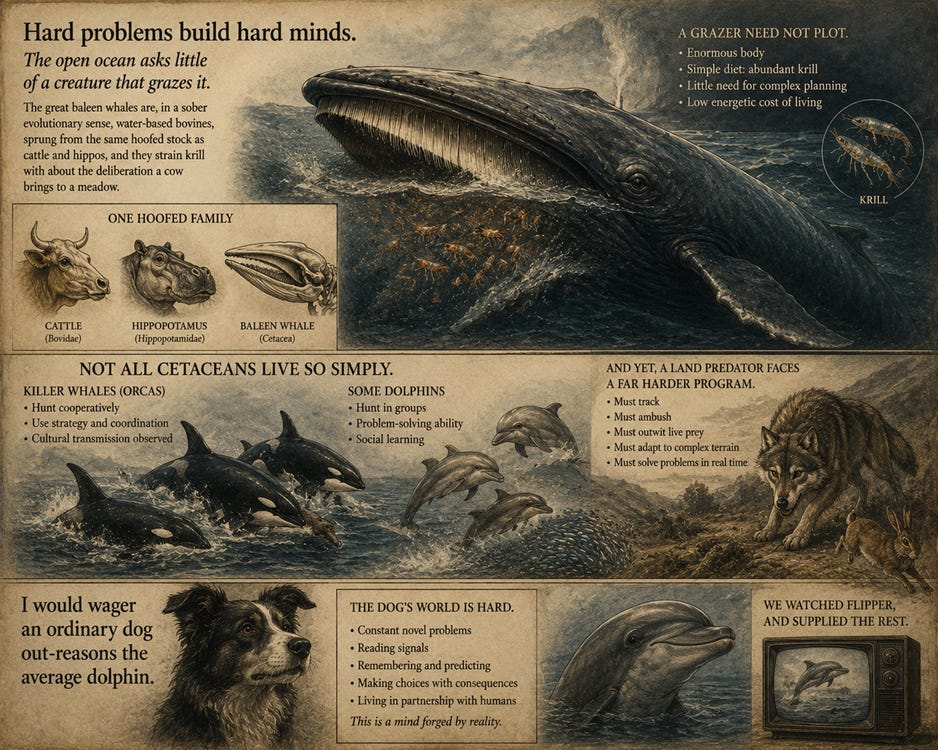
Paul Manger, the comparative neurobiologist at Witwatersrand whom I interviewed on the question, argues that the cetacean braincase is swollen less by intellect than by the work of staying warm. Much of that bulk is glia, the housekeeping tissue that heats neurons rather than the circuitry that thinks, and close to ninety percent of the relevant neurons carry proteins that shed warmth instead of processing thought. An animal living in subzero (°C) water bleeds heat with brutal efficiency, and a large, warm, well-insulated brain answers that emergency long before any intellectual one. We have mistaken the furnace for the philosopher.
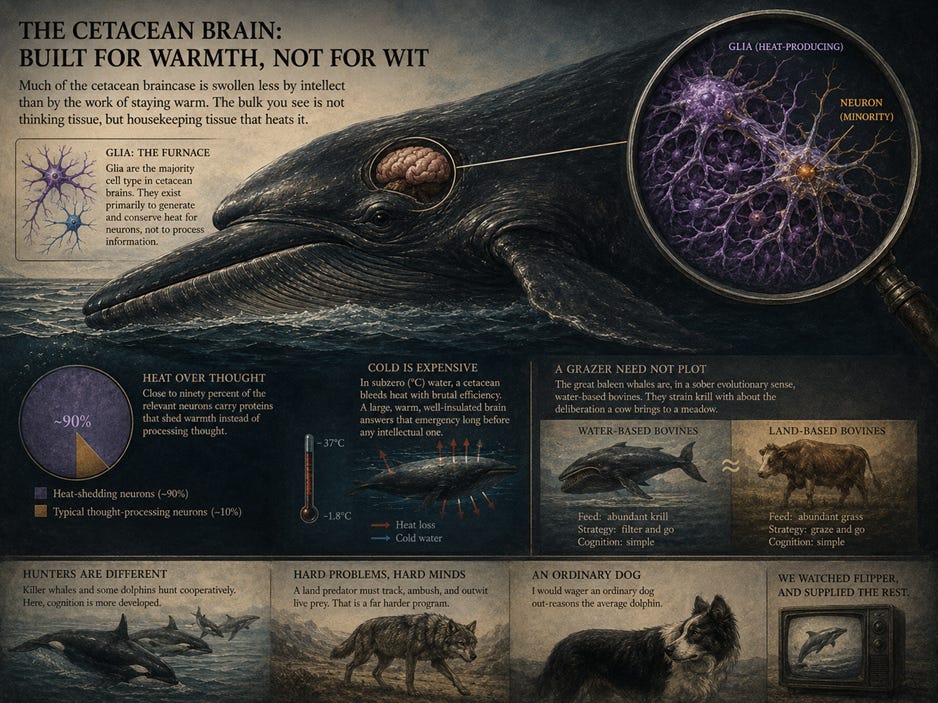
The structural point invites a behavioral one: hard problems build hard minds, and the open ocean asks little of a creature that grazes it. The great baleen whales are, in a sober evolutionary sense, water-based bovines, sprung from the same hoofed stock as cattle and hippos, and they strain krill with about the deliberation a cow brings to a meadow. A grazer need not plot. The killer whales and some dolphins do hunt cooperatively, and there the case for cleverness is strongest; even so, a land predator that must track, ambush, and outwit live prey runs a far harder program, and I would wager an ordinary dog out-reasons the average dolphin. We watched Flipper, and supplied the rest.
What is unique to us is not communication, which runs riot through nature, but the building of imaginary worlds and the persuading of others to live inside them. Perhaps that is why a slow, soft, poorly armed primate redrew the planet while the swift and the fanged did not. The decisive adaptation was not the hand or the spear or even the big brain as raw meat; it was the sentence, a finite handful of sounds and shapes turned into an infinite engine for conjuring what does not exist and then acting as though it does. From that one trick came religion, science, law, markets, and government, the whole apparatus of history.
From Ox-Horn to Bit
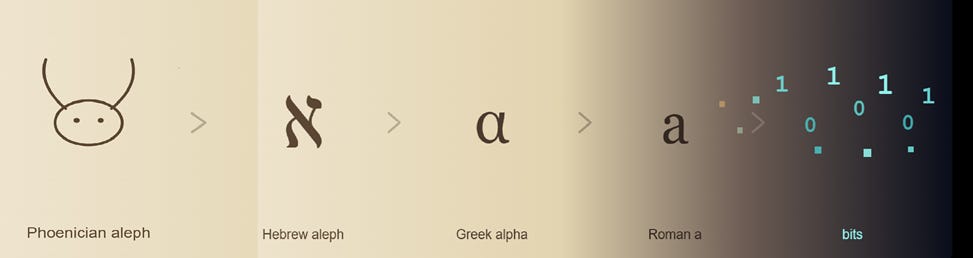
And the trick is still scaling. The ox-horn became aleph, aleph became alpha, alpha became A; the letter became a pulse of current, and the current became the bit, a grain barer even than a letter, nothing but on or off.
Out of those fixed grains we now conjure whole worlds and fling them through space at light-speed: our books, our films, our dreams, the very thought I am forming now, which will arrive entire in your mind a moment from now. No raccoon will ever dream of doing such a thing. The machine we raised on the bit is the loudest meta-message ever sent, built wholly from our gift for modeling what is not there; you could no more distill it from birdsong than raise a cathedral from a sparrow’s chirp. Animals signal; humans simulate, and the distance between those two verbs is the distance between nature and history.