“Tapering Is the Ideal”
an "EXPERT" tapers patients off one addictive drug for a living. Under oath, she called doing it with another "substandard care".

In January 2014 the Massachusetts Board of Registration in Medicine temporarily suspended my license to practice (though the saga ran for years; like the World Trade Center’s: an instant of destruction, a decade of restoration). Anyone who reads the Statement of Allegations can see what the board put at the top of its own document, ahead of everything else: not a botched procedure, not an injured patient, but its (wrong-headed, political) belief. Paragraph-3 records that I do “not believe that opiate addiction is a disease,” and that I hold it instead to be “a choice that can be changed through discourse and personal reflection.” The very next paragraph, with no apparent sense that it is undercutting the one above it, describes my treatment in neutral terms: buprenorphine for a set period, “typically no longer than four months,” tapered toward the end (which mind you was factually wrong, I tapered patients gradually throughout the entire four months period; a less than 1% per day decline in dose that was very well tolerated). The board had decided my protocol was heresy.
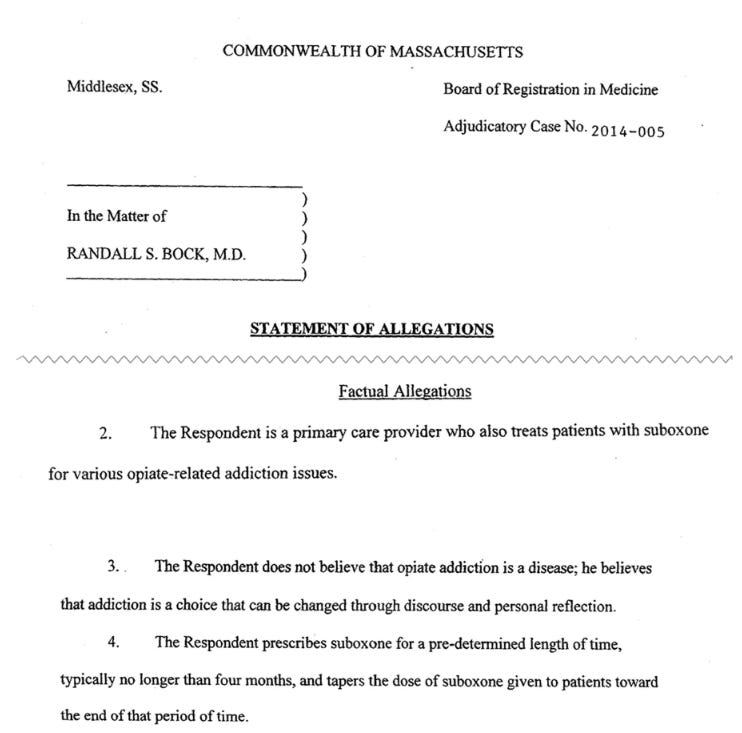
To turn even perceived heresy into a disciplinary charge, though, you need an expert willing to call it “substandard”. The board found one.
It is fair to ask how a book ended up at the center of a medical-board case at all. The answer is that I offered it to them myself, in good faith. In June 2012, the day after the board’s meeting on my issue(s), I wrote a courteous note to Dr. Gerald Healy, a member of the board and a physician of real stature whose questions (nearly uniquely amongst the erstwhile board members) were thoughtful, direct and inquisitive (in particular around my concepts around addiction). I offered to send him my YouTube links and the draft of my book, and singled out its first three chapters, where I had laid out the theory behind the work. I copied my own attorney on the note; there was nothing furtive about any of it – although I did (later, to a rankled board officer) have to apologize for the mere appearance of an “ex parte communication”.
As it happened, I never did send Healy the book. But the board had heard of it, asked for it, and I submitted it. That is when the trouble began. The manuscript I had volunteered, one colleague to another, became the document the board would spend years holding against me. No good deed goes unpunished.
The expert who read the book, not the chart
The board retained Dr. Olivera Bogunovic, (currently) medical director of McLean’s addiction outpatient program and an assistant professor of psychiatry at Harvard Medical School, board-certified in addiction- and in geriatric- psychiatry. On March 20, 2018 she testified under oath before Administrative Magistrate Kenneth Forton. I have the transcript open in front of me as I write this, and it reads less like a case against a physician than like a slow, courteous demonstration of a category error.
Start with what she had actually examined. The magistrate interrupted the direct examination to ask the obvious question. “Did you review any medical records from Doctor Bock?” Her answer: “No, I did not review the medical records.” Pressed on whether she had even been asked to, she said no again. What she had reviewed was my manuscript, then titled The Drug Whisperer, my YouTube videos, and the disclosure-and-agreement form my patients signed. So the “standard of care” she had been brought in to pronounce upon was never the care. It was the book.The board had gone for a board-certified Harvard appointee; but never tested her own published convictions, which, ironically, aligned with mine.
Magistrate Forton (apologizing that his were a layman’s questions) asked her from several angles, whether the act of writing and publishing a book could itself fall below the medical standard of care, apart from the treatment of any actual patient. There is a pause marked in the transcript. What she finally offered was not a clinical finding but a confession of discomfort: “I personally would have very big concerns if somebody has that opinion and is putting it in a manuscript.” Earlier, my attorney had asked whether she had any evidence that a single one of my patients had ever read the manuscript. “No.” The objection, stripped down, was that I had written my down my (unpublished, private) views. The expert’s act was in keeping with Savonarola’s (not Tom Wolfe’s) Bonfires of the Vanities.

Her own program, in her own words
(Following on from my erstwhile research) my attorney Douglas Matthews, asked her to describe her own work, running an outpatient benzodiazepine program at McLean. She described it herself: a small, careful program for patients who have been physiologically dependent for years, “up to 10 to 20,” some of them six years into a slow wean and still going. The method: gradual tapering toward none, with the family brought in for support and goals written into the treatment plan.

Asked what those goals were, she did not say lifelong medication; she said “getting a job and moving on in life,” and elsewhere, “rebuilding your life in setting of treatment.” Matthews then asked (in a more public program, without all of McLean’s resources), would “starting a taper carefully monitored” be a deviation from the standard of care? Her answer was a single word: “No.” She added that it was multifactorial, as everything in medicine is.
In a clinical trade interview she names outpatient benzodiazepine tapers as her own subspecialty and describes sitting with patients to discuss what they will gain from “long-term abstinence.” Her 2004 review in Psychiatric Services had already concluded that these drugs belong in short, low-dose courses, that gradual tapering serves the old as well as the young, and that impaired patients “show improved functioning once the drug has been discontinued.” And in 2018 -- the very year she testified that my opioid taper was a dangerous deviation -- she co-authored a review in Drug and Alcohol Dependence devoted entirely to how best to help patients taper off benzodiazepines altogether, a drug whose own withdrawal can kill. Her entire body of work is the patient art of getting people off a dependence-forming drug by walking them down to none of it.
Now hold the two halves of her testimony together. Taper a benzodiazepine patient down to zero: best practice, her life’s work, the thing she trains other physicians to do. Taper an opioid patient down to zero, as I did: “clinically dangerous,” a “deviation,” grounds to take a man’s license. Same goal, same method, the same clinician sitting in judgment. The only variables that changed were the molecule and whose name was on the chart.
“Tapering is the ideal”
The magistrate, still playing the patient layman, eventually asked her the question directly. It seemed to him, he said, that “tapering is the ideal if the person can take it; is that right?” Her answer: “If the person can take it, it’s ideal.”
There it is, in the transcript the board itself produced: the Commonwealth’s own expert, under oath, agreeing with the doctor the Commonwealth was trying to strip of his license. The dispute, once you take off its costume, was never about whether to aim a patient at sobriety. Bogunovic aims her own patients at sobriety. It was about whether a physician is permitted to say so out loud, in print, and to doubt the orthodoxy that says the aiming should never end.
A disease “by definition”
The most instructive stretch of the day had nothing to do with me at all. It was the untrained and unembarrassed magistrate’s testing the foundation under the word everyone kept using. The profession calls addiction a brain disease largely on the strength of what shows up on scans -- the PET and MRI changes she invoked. Yet no patient is ever diagnosed or dosed by scan. As she conceded, “it’s the clinical picture that drives the recommendation ... There’s not a requirement to do an MRI scan or PET scan; that does not exist right now.” So the physiological proof that supposedly makes addiction a disease plays no part in deciding who has it or how to treat him. The magistrate put the contradiction gently: the physician community rests its conclusion on “physiological observed phenomena,” and then treats patients without reference to those phenomena at all.
And consider what those scans actually show. The brain changes (measurably on such scans; not physically or morphologically)-- when we fall in love, when we grieve, when we learn a language or take up the violin. No one calls falling in love a brain disease. A functional image of the brain is akin to a infrared-thermal image of your home: the kitchen glows at dinnertime, the bedrooms late at night, the heat migrating from room to room as the household goes about its day. Or think of the old telephone switchboard, this line busy now and that one idle, the pattern forever shifting with the traffic.
To point at heightened activity in the reward circuitry and announce a permanent disease is to mistake a house’s being lived in for its being broken. And we know it is not destiny, because people climb out -- sometimes with medicine, sometimes through work or family, sometimes, as I have watched, through nothing more (or less) clinical than finding God. A permanent, choice-erasing brain disease (like schizophrenia) does not lift when a man is “born again”.
When he asked her, repeatedly, to ground the disease claim in evidence, what came back was not evidence but a roll-call of institutions: the National Institute on Drug Abuse, Nora Volkow, the American Medical Association, the DSM-5. Asked whether any reputable body disagreed, she answered, “Not any reputable organizations that I’m aware of” -- which the magistrate, drily, called “a cheeky way to respond.” And when Matthews reminded her that homosexuality was once classified as a disease and later was not, she granted the point without much fuss. Categories move; maps are redrawn. “It is a brain disease by definition,” she had insisted earlier; but by definition is precisely the circular-logic phrase we reach for when we have decided in advance not to examine the thing we are defining.
What an afternoon proved
This was the testimony upon which the board’s case rested. After we had discovered the 2014 hearing had applied the wrong evidentiary standard, the same magistrate reheard it and concluded that I had not provided any substandard care to my patients.
We taper people off benzodiazepines. We taper them off alcohol, and off nicotine, and we count it a success, not a malpractice, when the prescription pad finally goes back in the drawer. Nobody calls weaning a patient toward sobriety a deviation from the standard of care, except in the one province of medicine where lifelong maintenance has been written into statute, funded by the state, and turned into a recurring revenue line: the “Methadone Industrial Complex” (which includes Suboxone/buprenorphine).
I argue the larger version of this elsewhere, and at length, in my upcoming book “Withdraw to Freedom: Navigating the Addiction Maze”. But the smaller version fits in a single sworn afternoon: tapering is the ideal. Massachusetts’ Board of Registration in Medicine’s own assigned expert said so herself.
Physicians holding opposing beliefs and theories is a normal part of scientific discourse - I am baffled by some of the decisions by medical boards these past 15 years especially.
This reminds of the 2 years I worked for Montefiore Hospital about 35 years ago. They had a Methadone clinic nearby and I couldn’t understand why they didn’t treat drug use as the addiction that it is.
At that time I was over 20 years clean and sober and it just took determination and a wonderful group of people to show me the way.
Keeping people on these drugs for life ruins their prospects for a good life in so many ways!