When Inclusion Becomes Exclusion
An examination that happened only in the chart, and a physician who chose not to call a man “he”

I went to a new primary-care physician to establish care and to have an annual physical, and I came away with two complaints. Her note recorded an examination she had not performed, and her note repurposed me, an obvious guy with a few obvious, medical, “guy-“ problems, as one of today’s non-binary crowd, a “they.” The first is a question of both competence and honesty (while upcoding and up-charting for cash); and the second is a question of medicine’s philosophic direction. This essay takes them one at a time. Here is how her record of my visit begins.
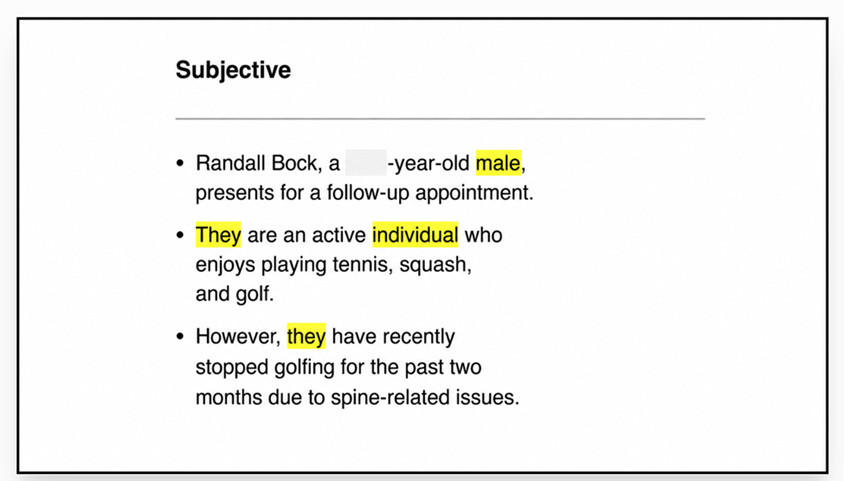
The opening lines of the note. “Male” in the first sentence, “they” in the second.
The Phantom Examination
The annual physical is its own billing category. It pays well above an ordinary visit, an initial visit with a patient my age probably adds something further, and it pays that way because the physician is supposed to have performed a comprehensive examination and then some. A record’s describing services never delivered is a serious dereliction, akin to plagiarism or fraud; essentially cribbing and confecting data.
The work is not heavy lifting either, and it matters on its own account. An examination exists to confirm or contradict what the patient reports, which counts most where the words are unreliable, (e.g.) since people (who are not physicians) conflate vertigo and lightheadedness as “dizzy”. The examination decides. Ironically, I had been having some degree of each of those symptoms. Nothing in the visit nor her (nonexistent) synthesis suggested that she was weighing either one, let alone one against the other.
She performed this physical exam chart-aggrandizement on one who happens to be a physician; the implication (therefore) is that she uses the same shave by Hanlon’s Razor for everybody. Every physician I know, whenever an attorney, professor, or physician presents as a patient is circumspect in writing up the chart; making it an extra- thorough, -comprehensive, and -accurate note (acknowledging that every church should be that way) .
I never really had this problem because frankly I started using Dragon dictation 40 years ago – and much as you might assume from reading this essay, I’m a pretty thorough guy. So I would dictate as much note as was necessary and do it in less time than others might take to handwrite or type it. Even before Dragon— in medical school and residency, my notes got compliments from attending physicians as the standard to which others within the class should aspire. I’m not saying I was stellar across the board, but my chart-notes were pretty good. Acknowledging that’s not how everyone rolls, it still is incumbent upon a physician to be truthful transcribing this medical (and possibly legal) data point. What remains open is whether this physician cannot perform the requisite examination(s) or would rather not (while making believe that she had)-- and neither answer is comfortable.
The Borrowed Logic
The second complaint is the one worth its own separate essay. Ibram Kendi and Robin DiAngelo persuaded a generation of institutions that the cure for old discrimination is fresh discrimination pointed the other way, which comes to one tribe’s raiding a second because a third raided somebody a century ago. That is not repair and it is not growth. The histories are not parallel, since nobody was ever enslaved for being trans, and the logic has been copied over intact anyway. Say that boys should not compete in girls’ sports and you are anti-trans. Ask that a chart describes a man using the word “he”, and your syllogism has become a “Belief.”
The Garage
A doctor’s office ought to run like a good garage staffed by people with longer degrees. Bodies have systems the way cars have systems, and the specialties were built to match, so the gastroenterologist takes the fuel line, the cardiologist takes the pump, and the dermatologist runs the paint and detail shop. The generalist knows the whole machine, and a good one does far more of the work himself than people assume. Examinations from retinal to rectal (not simultaneously of course), minor surgery from ingrown or overgrown toenails, to ocular foreign bodies, earwax, warts, and actinic keratoses – as well as treatments for pneumonia, diabetes, alcoholism, you name it. These were all mine, and each of those sent out (when it’s something you yourself could have done) becomes several visits and additional patient bills.
My own mechanic is a grizzled old man who talks with me and gets to the root of the problem, and I have been to the other kind, the ones who upsell. Honest work and an accurate invoice are all either trade owes anybody, and cars have insurers too. I do not want his deciding my sedan is an airplane: putting wings on it-– or removing the wheels because I told him it’s a submarine.
The Visit
I am not young; yet don’t have that much call for medical visits. I maintain a (relatively) slim physique and a low-risk life: no smoking, careful habits; with hang gliding left to riskier others. Nonetheless, a physician of record is still required, because the bureaucracy wants a few prescriptions blessed by an MD (not named “me”).
My previous doctor moved through several practices and has now stopped seeing patients. Zocdoc had served me before and could have served me again. One Medical (I believed) was worth a try because Amazon owns it and would endow it with some nice tech; letting patients reach medical advice online— and the membership costs but $100/year, ~only 1% of a concierge practice’s fee.
There is one difference worth admitting. The concierge patient is doubling down on a well-liked doctor; paying to keep him close— while I was physician-shopping. What arrived appears to have come from the bargain bin: dogmatic without much experience; a poor combination in any trade.
Membership had already proved useful once before (for refills between visits), although an actual One Medical physician was someone I hadn’t yet seen, since the membership lapsed more than a year ago and I rejoined only this year. So I waited the extra weeks for a doctor rather than take the earlier slot with a nurse practitioner. Call her “Dr. Hadley Worthington” (to somewhat spare this physician).
The Hidden Mic
During the actual visit, I had been talking a while, and at one point I said that what came next was “between us”. That was her moment to mention that some device was recording us; yet she let it pass. A little later, with the intimate material already out – and we were on to more mundane items, I noticed that she was writing almost nothing down. I asked why, and she told me the visit was being recorded.
Looking up, I saw the device on the wall, about the size of two bars of soap, and no camera anywhere; some version of Alexa had been sitting in. She mentioned that I had approved such in the pre-visit paperwork. No doubt that is true; but a checked box is still not a disclosure.
Massachusetts requires the consent of both parties to a recording and takes that rule seriously in every other setting, and one sentence at the start of the visit would have covered it. Had she spoken up when I said the words between us, I could have confirmed the box or denied it, and the two-party question could have been settled before the intimate part, instead of after.
What I Brought
I’m doing pretty well overall, but I’ve had some recent vertigo, a visual disturbance, rotational back pain, and one abnormal laboratory value. I stood up and showed her how little I can bend. The thoracic spine into the upper lumbar carries bridging osteophytes across the facet joints and vertebrae, congealing them into something close to an auto-fusion (which sounds like a car-model), and on film the whole run looks like wax dripping down a candle.
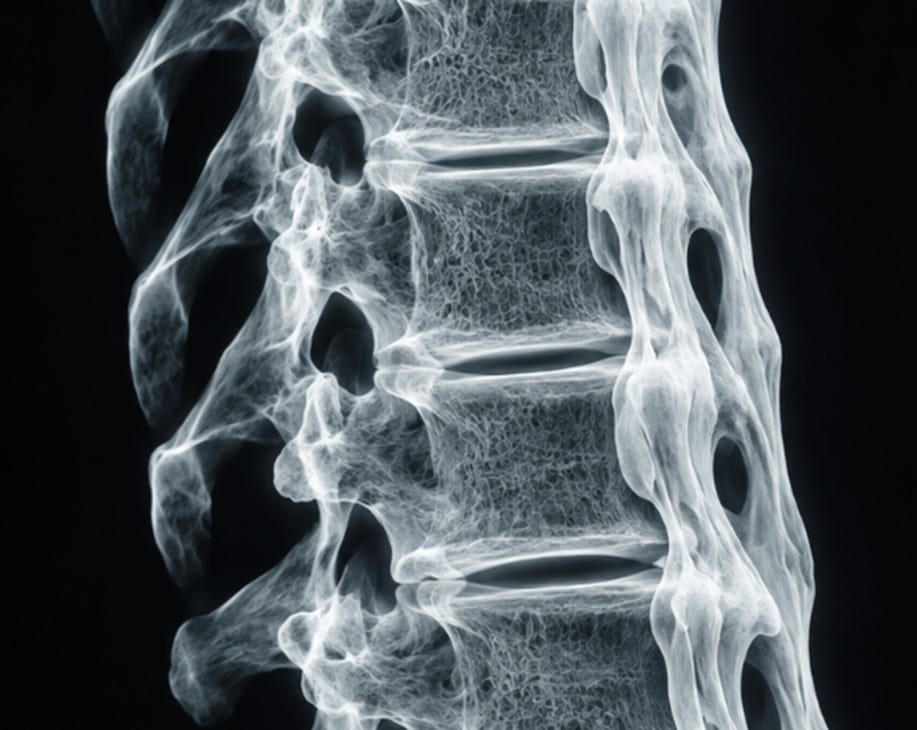
(AI-recreation) The osteophytes bridge the vertebrae, impede movement.
Time was not the problem. The country is said to be short of primary-care physicians, yet at a prime-time a.m. weekday visit I intersected with only one other patient (who left before I started). A practice that empty at that hour may speak for itself; while at the same time she did very little actual speaking within the practice. All of my varied problems elicited really no comment from her, no advice, no real plan. The word “doctor” shares the same root as “doctrine” and is given to us because of our role as teacher, guide for the patient.
The Checklist
What she gave me instead was the vaccine list. It began with how long it had been since my last tetanus shot and continued through shingles, RSV, and pneumococcus, and she did not miss one. That list is where the money and the quality metrics live now, and she worked it perfectly.
My understanding, which needs verifying, is that a physician in these arrangements is not paid for the shot itself. The boxes get counted, the volume shows up in the aggregate, and something like a sales bonus follows. That turns a doctor into an agent for a product, which is a different job from the one on the diploma.
Tetanus is a good example of medicine’s running on a script. The rusty nail comes to us from a world with horses and manure in the street, so that a puncture was a serious affair. Horses still exist, but not on Comm Ave.. In decades of medical practice not one case of tetanus has crossed my path.
My father used to tell my cohort of local kids he was the lion catcher for The Bronx. When they invariably parried, “There are no lions in The Bronx!”; he would reply, “You’re welcome!” The same argument can be made for the tetanus vaccine (no dray horses extant).
The Examination
Vertigo in a man my age earns a few minutes of neurologic attention, and the maneuvers cost nothing. Gait across the room, Romberg, finger to nose, reflexes, cranial nerves, blood pressure lying and then standing, and the positional test that separates an inner ear from something belonging in a scanner.
None of it happened. She had me follow her finger, shined a flashlight toward my eyes; had me raise my thighs against pressure, lightly touched my knees, over the pants-barrier— and that was the whole of the neurologic examination. She looked in my ears and my mouth; and listened to a few spots on my chest, front and back. My shoes and socks stayed on (so the pulses and the sensation in my feet went unchecked) and my business clothes stayed on (so no skin aside from face and hands’)was ever seen). I never laid flat on the exam bed.
Case-Finding
A patient brings symptoms, which are his own account and subjective by nature. A physician looks for signs, which are objective, and which may confirm the account, contradict it, qualify it, or turn up something the patient never knew enough to mention. The patient therefore takes part twice, actively by telling his story and passively by bringing his body into the room for someone trained to see what he cannot.
A man reports vertigo, and the examination finds nystagmus, an unsteady gait; conversely it’s “lightheadedness” (near syncope) with blood pressure pressure that falls as he stands; or some other asymmetry that moves the problem into a different category altogether. A man may not notice any trouble with his legs; yet the examination finds weak pedal pulses, cool feet, thin shiny skin, and the hair gone from his calves, which taken together point toward arterial disease. I have found more than a few (otherwise occult) abdominal aortic aneurysms and melanomas through physical exam. Occasionally, one finds toenails, thick and twisted and long neglected that speak volumes.
None of that argues for running every traditional maneuver on every healthy adult, on every visit – and the evidence has properly retired some of the old rituals (I no longer do digital rectal exams; female breast exam may be superseded by regular mammography) – yet, feeling fine and having a normal examination are two different claims. It is the physician’s (literal) job to ensure that the latter goes with the former.
What was missing from my visit was not only the warranted complete physical exam, but any evidence that my expressed symptoms were being turned into hypotheses and tested against the body that I (conveniently enough) had brought to the visit. The one subject that did run fluently for Dr. Worthington was the vaccine list. Reciting a prepared menu is a great deal easier than doctoring, which starts when the patient says one thing, the physician sees another, and a trained mind decides whether the two belong together.
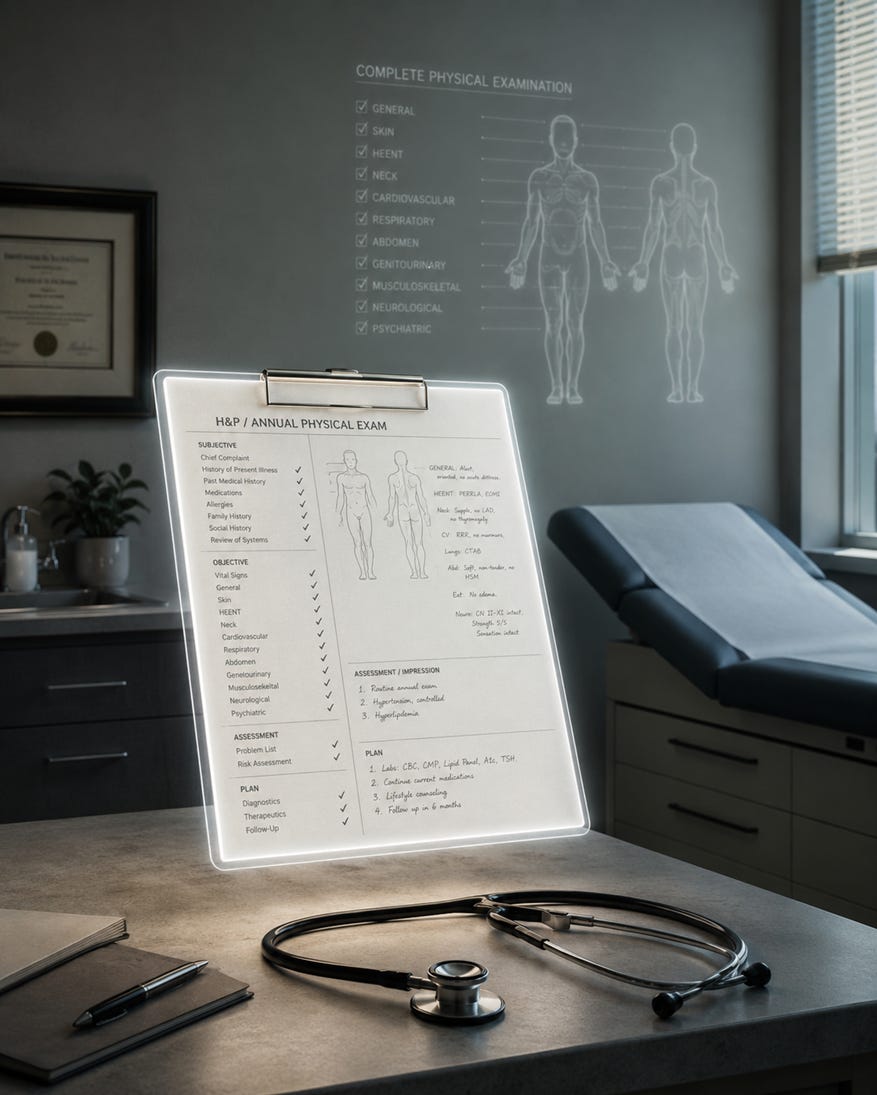
The Chart
The note described a different visit. Here is what it recorded, beside what took place.
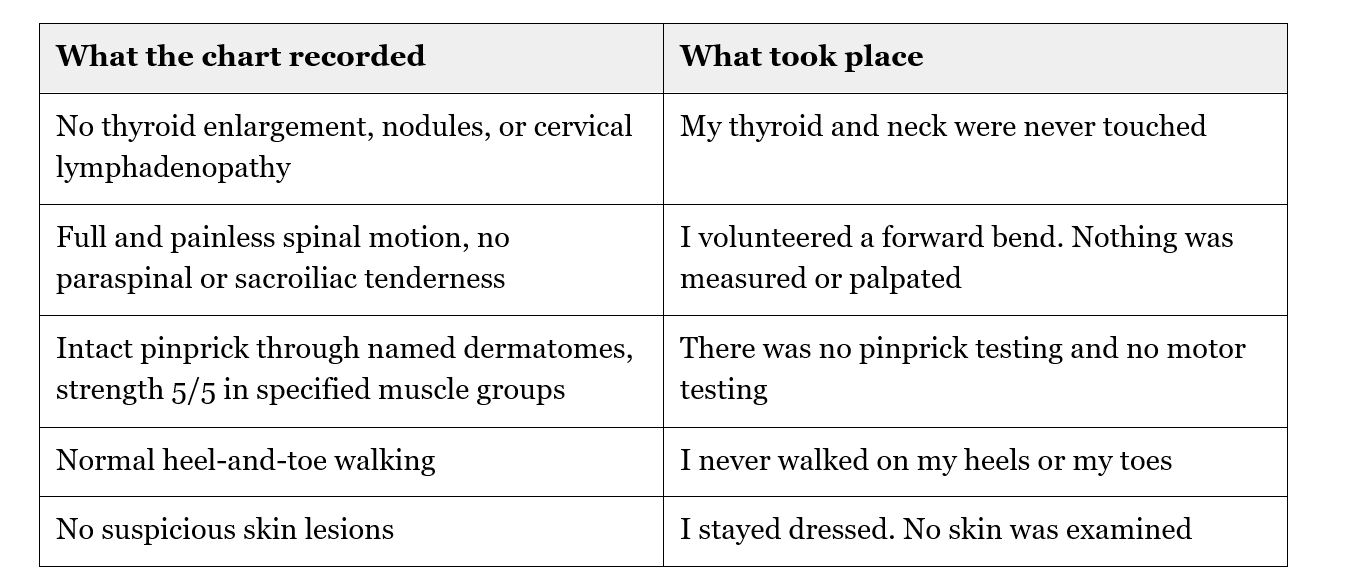
I wrote to her, mentioning the discrepancy between reality and her description of it.. Dr. Worthington answered: “You’re correct that the documentation (sic) included findings from examinations that did not occur, and I apologize for that error.” She has since appended a revision.
Pro-noun, Anti-man?
A “male” in the first sentence, a “they” in the second, and a “they” in every sentence after that. The note calls me an “active individual,”; discordant with the plural “they”. It also calls a first meeting a follow-up appointment.
A few lines further on: “they report limited portionability (sic)”. I assume she meant “torsion ability”. This shows that it’s Dr. Worthington’s having written the note (not Alexa). Alexa can’t come up with a word not in its lexicon (so, no Alexa-cons).
In records from the cardiologist several years ago, I am a “he” from beginning to end. Something changed with One Medical. The physician assistant I had seen via video had done the same thing.
The Explanations
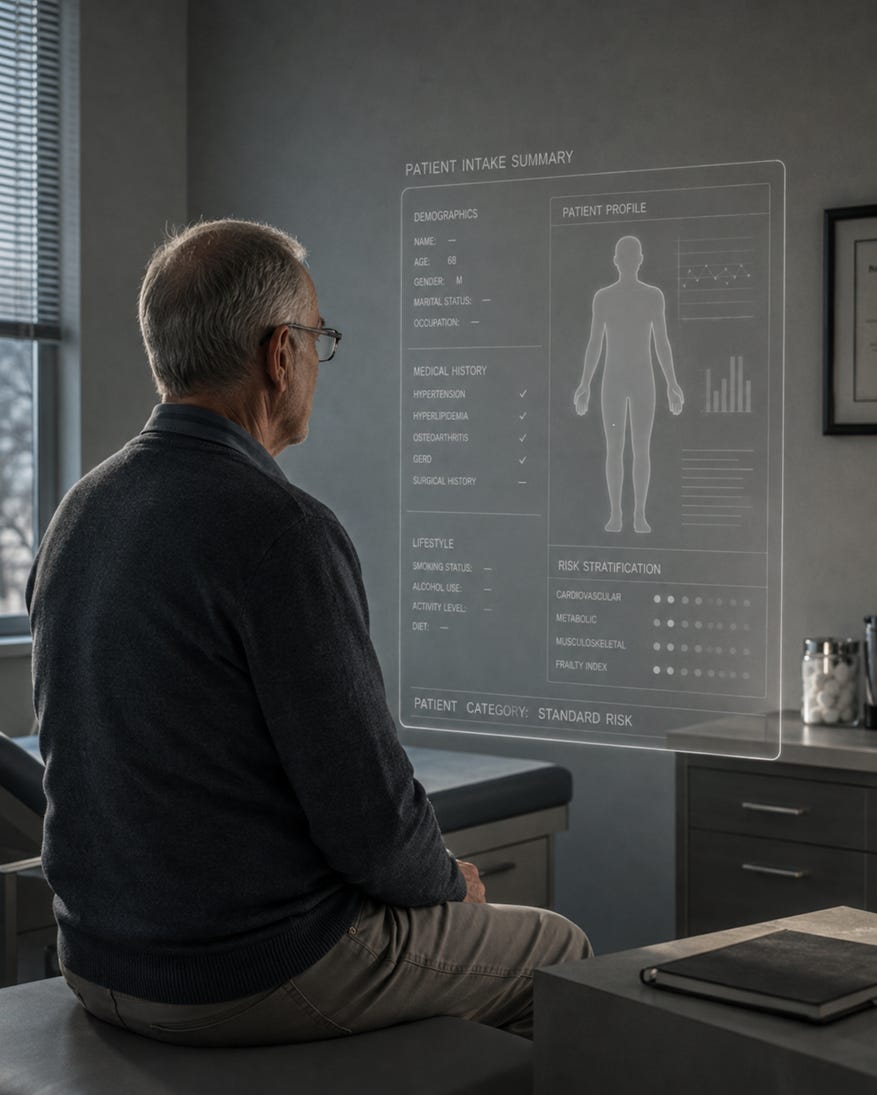
Her first answer was direct: “About the pronoun usage, I use ‘they’ as a gender-neutral term in clinical documentation as part of our standard documentation practice.” She had noted my preference so the team would not use it again, she respected my beliefs about sex and gender, and she hoped I would respect the way she and others at One Medical practice medicine. Look at what the word “beliefs” is doing there. Her usage is “standard” and mine is a “belief”. My being a man is (for her) a presumption, not a fact.
After I pressed, the account changed. She had found that “they/them” was already selected in the system, and used it for that reason. How can her two phrases coexist? Especially since that same chart-review revealed my prior answer in the gender-description field, literally: “There is no difference between sex and gender. The profession of medicine should not indulge in this current social contagion.” Her second explanation arrived only after the first had become too awkward to maintain. Neither answers the simple question, which is why she never asked the man sitting three feet in front of her.
The Reversal
Turn the facts around for a thought experiment. A brand-new patient gives a very contemporary set of “preferred pronouns”; yet the physician, via the chart, ignores that, whereupon the physician calls the objection a “belief”, later blames a computer field, and then “fires” the patient after civilly questioning her action. In Massachusetts, that’s front-page news; (strong-arm) grandstanding by Liz Warren, Maura Healey, and Janet Wu; followed by a case both at the MCAD and the medical board.
The public-accommodation law here prohibits distinctions based on sex, gender identity, and sexual orientation, and it (theoretically) does not reserve those protections solely for claimants of the (newly politically) correct description. In actuality it likely does. If I were to hold my breath until my situation reached the Boston Globe, I would have cyanosis. Discrimination can run in either direction, but only one direction has a political thumb on the scale.
The Dismissal
The visit itself was not difficult. On the way out I told her it might have been tricky having a physician in the chair, since that can make a doctor tentative, as though someone were grading the exam. Physicians make the worst patients, I said, and I hoped I had not been hard on her. She tittered a little and said no, it had been fine.
From my side of the medical desk it has never been a problem. Treating physicians is easier than the alternative, because the basics can be skipped and the conversation starts where it should. Some people need to be the smartest one in the room, and a patient who knows the material becomes a threat rather than a shortcut. Her last message read that way, saying she had found our interaction “very challenging,” that my concerns about her judgment, discretion, and documentation meant I should establish care elsewhere, and that every patient deserves complete trust in a physician.
My doubts did not precede her errors, they were produced by them, and she treated the product as the defect. I read my record, found specific inaccuracies, asked that they be corrected (and that “they” be corrected), and got an admission that I was right— whereupon ‘Dr. Hadley Worthington’ immediately removed me from her practice, firing the patient who was right. Putting findings in a chart that were never gathered shows what the work is worth to her, and entering a man as “they” shows what the science is worth. In my training the second would have been called proselytizing, and it would have put a student’s place at risk.
The Rule
The old bumper sticker said never trust anyone over thirty. I would invert it and put the line at forty, because a physician trained before the change still treats the body as a mechanism and the chart as a description of what happened in the room. This is not nostalgia. Older doctors made plenty of mistakes, but at least they made them earnestly.
No affirmation was wanted here, and no agreement about politics. I wanted a physician to examine me, write down what actually happened, and answer like a professional when the record proved false. When expectations that modest become controversial, the trouble is no longer a pronoun or a note.
"When you "assume", ... "
as the saying goes
hard to get past the first sentence when you refer to the Dr as “her”. just shows your ignorance, she was clearly a “they” also…