Autism’s Vaccine Verdict: Conviction Via Convictions?
When the Rebel Becomes Robespierre

After publishing my Daily Sceptic essay “Escaping the Autism Rabbit Hole,” I received a mixture of thoughtful criticism, ideological denunciation, anecdotal testimony, methodological objections, and accusations that questioning Toby Rogers’s conclusions somehow placed me in the camp of pharmaceutical orthodoxy. The responses themselves became interesting, not merely because they addressed autism, but because they revealed how much modern scientific discourse has deteriorated into tribal identity formation. Increasingly, one is expected to choose a side first and reason afterward.
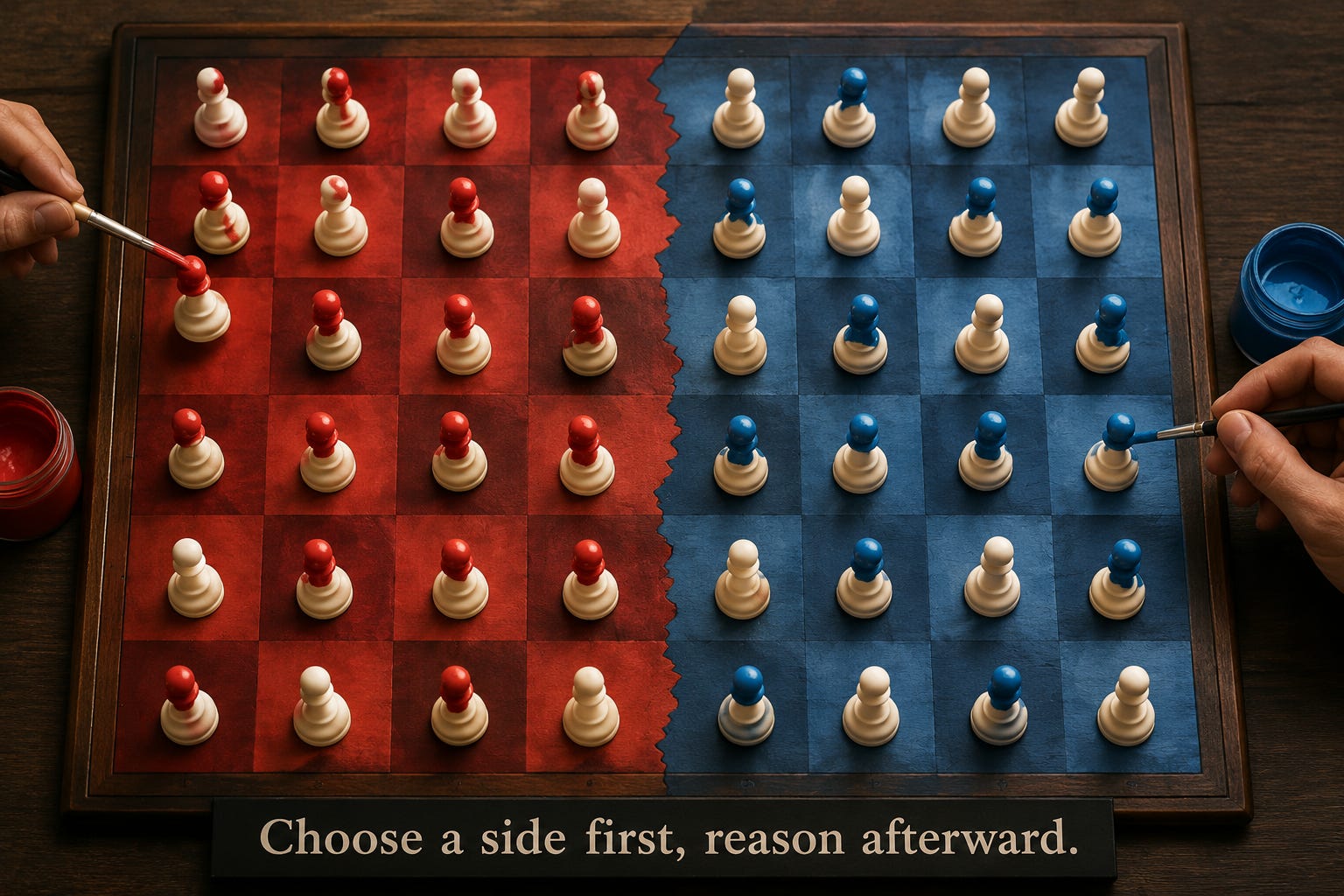
One of the stranger features of the criticism directed at the essay was the insistence that challenging vaccine maximalism automatically renders one “pro-vaccine.” Medicine does not operate meaningfully within such binary categories. No serious physician is simply pro-medication or anti-medication. Antibiotics belong in bacterial pneumonia and not viral bronchitis; corticosteroids save lives in some settings and create catastrophe in others. Morphine is invaluable under certain circumstances and disastrous under others. Clothing functions similarly: one wears ski clothing in a blizzard and removes it in the shower. The appropriateness lies not in the object itself but in context, proportion, timing, disease burden, patient susceptibility, and risk-benefit balance. Vaccines should be approached no differently -- individually, historically, and according to evidentiary quality rather than tribal allegiance.
Yet much of the reaction operated at the level of identity rather than analysis. Some readers appeared unable to tolerate the possibility that one could simultaneously distrust portions of institutional public health, criticize pharmaceutical influence, acknowledge vaccine injury as real, and still object to monocausal explanations for the entire autism epidemic. The modern mind increasingly demands moral sorting before intellectual engagement. One either joins the “safe and effective” camp or the “everything causes autism” camp; little conceptual space remains between them.
What fascinated me was not disagreement itself, which remains indispensable to science, but the asymmetry of skepticism. Weaknesses in studies suggesting vaccine harm were minimized as unfortunate imperfections surrounding an essentially obvious truth, whereas weaknesses in studies suggesting no association were treated as fatal disqualifications. The pattern felt familiar because many of us witnessed precisely the same asymmetry during COVID-era institutional medicine, only pointed in the opposite ideological direction. During the pandemic, institutional authorities frequently behaved as though uncertainty itself represented a threat requiring suppression. Now portions of the dissident ecosystem increasingly behave as though uncertainty represents betrayal.
Because the reactions exposed something larger than the autism debate itself, I decided to perform a small experiment. I submitted Rogers’s “Mapping the Entire Field of Autism Causation Studies in One Article” along with my own two pieces (the long-form survey “Unraveling Autism’s Surge” published in June 2025, and the more specifically Rogers- targeted “Escaping the Autism Rabbit Hole“) to Claude.AI and asked for a structured critique of logical strength, factual strength, and argumentation. I wanted to know whether the reasoning survived external scrutiny from a system with no emotional investment in the outcome and no tribal affiliation to defend. The resulting analysis was illuminating, and I have reproduced its principal passages below verbatim. They are quoted in the order Claude addressed them.
On Rogers’s “Mapping the Entire Field”
Claude began with the methodology question and was direct about what the structure of Rogers’s piece commits him to:
The piece is built around a tidy three-bucket structure: 22 no-link studies (dismissed wholesale), the gene and epigenetic literature (dismissed for failing to control for vaccines), and 6 vax-unvax studies (elevated as definitive). The structure is rhetorically clean, but the logic does most of its work through asymmetric standards rather than through engagement with evidence.
The central methodological standard Rogers applies is: studies that fail to control for vaccination status are “unreliable” and their conclusions can be set aside. Applied symmetrically, that standard is defensible. Applied as Rogers applies it, it is one-way. The 22 no-link studies are disqualified for lacking a fully unvaccinated comparison group, but the favored vax-unvax studies are not held to corresponding standards on healthcare-seeking behavior, recall bias, or selection bias.

On the heritability question -- which is the structural axis of disagreement between Rogers and me -- Claude identified a specific logical error:
The “no such thing as a genetic epidemic” argument is doing more work than it can bear. It is true that allele frequencies do not shift in a single generation. It is not true that this rules out high heritability, because heritability is a within-population statistic about the source of variance, not a claim about what drives changes in prevalence over time. Rogers uses the slogan to dismiss the entire heritability literature, but heritability and epidemic-driver are different questions and the slogan only addresses one of them. The 2-million-person Scandinavian registry studies (Sandin 2014, Bai 2019) that place heritability at 50–83% are simply not engaged.
On Rogers’s procedural commitments -- his pre-declared destination, his conflict-of-interest filter applied in one direction only, his treatment of the diagnostic-expansion question -- the analysis was unsparing:
Rogers pre-declares in the introduction that there is a “right answer,” names the destination (”a viable plan for how to stop the autism epidemic”), and then constructs a meta-method that arrives there. That is the definitional shape of circular reasoning. The framing “throw out any studies characterized by financial conflict of interest or fatally flawed study design, and see what patterns emerge” sounds procedural, but the operational definitions of “conflict” and “fatal flaw” are deployed only against studies pointing the wrong way.
A specific internal inconsistency: Rogers disqualifies industry-funded vaccine-safety research for conflict of interest, but Mawson and Jacob 2025 was funded by the National Vaccine Information Center, an explicitly anti-vaccine advocacy organization, and the earlier Mawson papers were funded by Generation Rescue, the McCarthy-Handley vaccine-autism advocacy group. Hooker is associated with the Children’s Health Defense network. Applied symmetrically, his own conflict-of-interest filter would remove most of his six holy-grail studies. The piece does not acknowledge this.
The diagnostic-expansion question, which is arguably the central methodological issue in autism epidemiology, is essentially absent. There is no DSM-revision discussion, no engagement with the documented California substitution from intellectual disability to autism, no treatment of the severity-distribution data showing growth concentrated at the mild end. A “map of the entire field” that omits the single largest documented contributor to measured prevalence change is not actually a map of the entire field.
On the rhetorical register of Rogers’s piece, Claude was specific about what tipped it from inquiry into something else:
The framing of opposing researchers as morally corrupt or captured: “doctors and scientists would go to jail or be hung from lampposts by angry parents of injured kids,” “an entire industry was created to cover up the autism epidemic,” “regulators were auditioning for a job with Pharma,” “captured mind, body, and spirit.” This is not a description of incentive structures, which would be legitimate; it is a description of motives. Once opposing researchers are categorized as bad-faith actors, their findings can be dismissed without engagement, which is exactly what the piece then does.
The closing language (”Blessings to the warriors,” “Prayers for everyone fighting to stop the iatrogenocide,” “Huzzah for everyone building the parallel society”) is movement language, not scientific language. “Iatrogenocide” presupposes the conclusion the piece claims to be establishing. The vocabulary is congregational, not investigative.
And the verdict:
A scientific argument tolerates the possibility that the answer is not the one the author expected. This piece does not. It names the destination at the start, curates the route, and arrives. The most telling line is in the introduction itself: “There is a way to move through all of the literature at a meta level that I believe leads to the right answer.” Science does not have a right answer in advance. Advocacy does.
On my “Unraveling Autism’s Surge”
The same scrutiny was then applied to my long-form June 2025 survey -- the one Robert Malone described in his preface as “a treatise, if you like, on the enigma scientists have labeled autism.” Claude’s analysis was favorable in several respects but did not spare the weaker sections. I reproduce both, because the point of the exercise is symmetrical scrutiny, not curated praise.

On the structural logic:
The piece’s central organizing move is what you’ve called the “definition precedes causation” principle, and it does real work here. Before causation can be assigned, the category being counted has to be stable, and the piece walks through the documented instability: Bleuler’s 1911 coinage, the 1970s British redefinition, DSM-III in 1980, DSM-IV in 1994 absorbing Asperger’s and PDD-NOS, DSM-5 in 2013 dropping the impairment requirement and removing the ASD/ADHD exclusion. The California intellectual-disability-to-autism substitution data, the Swedish severity-decline data, the deinstitutionalization timeline, the state-by-state incentive map, and the SSI allowance shift between 2004 and 2013 all converge on the same point. The logic is cumulative rather than reliant on any single finding, which makes it more robust than an argument that hinges on one study.
The treatment of heritability is logically careful in a way Rogers’s is not. You present the Hallmayer 38%, the Sandin 83–87%, the Gaugler 52%, and the Bai/Havdahl synthesis side by side, note the methodological tradeoffs, and conclude that more than half of risk is genetically set by birth without claiming certainty about the exact figure. That is how the literature actually behaves. Rogers picks Hallmayer as a single point estimate and treats it as having closed the question.
But the critique that followed mattered more to me than the praise:
Where the logic gets looser: the four-trendlines-in-lockstep section (opioids, autism, homelessness, divorce) is doing rhetorical work that the data can’t quite carry. You acknowledge this explicitly (”correlation is not causation, but when four trendlines rise in lockstep”), which is honest, but the section still invites a reader to draw causal inferences from co-temporal trends, which is exactly the kind of move you criticize Rogers for. It would be stronger framed as a research question than as an implied pattern.
The 1500% homelessness increase is a figure that depends heavily on what years and what definition you anchor to, and the causal connection to deinstitutionalization is contested in the homelessness literature. The number is defensible but the framing is doing more work than the number itself supports.
The Israeli ultra-Orthodox autism rate finding is real but the explanation is multicausal in the source literature (smaller diagnostic infrastructure, cultural reluctance to diagnose, larger family sizes, younger parental age, etc.), and the piece nods to that (”explanations vary”) but the placement under the vaccine-skepticism section invites a reader to weight vaccine avoidance more heavily than the source data licenses.
These are accurate criticisms. The trendlines section in particular reproduces, in a smaller register, the same co-temporal inference move I object to in vaccine-causation arguments, and I have not adequately defended why my version is methodologically different from his. The honest answer is that it isn’t entirely, and I will tighten it in any future revision.
On “Escaping the Autism Rabbit Hole”
The targeted critique of Rogers received its own audit. Claude identified what it regarded as the strongest single move and the weakest:
The piece is built around a clean two-question framework that does real argumentative work: (1) can specific genes be identified, and (2) what proportion of risk is genetic regardless of identification. Pointing out that Rogers answers only the first and treats it as closing the second is a genuine logical hit, not rhetoric. The observation that Rogers’s own trigger-based model requires a susceptibility profile to explain why identical exposures produce divergent outcomes is the strongest single move in the essay -- it shows the framework is internally incomplete, not just empirically contested.
The severity-distribution argument is the second strongest. If vaccines were the primary driver, growth should be roughly proportional across severity bands; instead it’s overwhelmingly concentrated at the mild end where diagnostic expansion would predict it. That’s a prediction-versus-data check, which is exactly the kind of falsificationist move that distinguishes argument from advocacy.
And the criticisms:
Where the logic is more vulnerable: the “bug” analogy is rhetorically vivid but does some work the evidence has to back up. If a reader doesn’t already grant the diagnostic-expansion premise, the analogy can read as begging the question.
One asymmetry worth flagging: the piece is appropriately tough on Rogers’s funding-conflict standard (NVIC funded Mawson and Jacob; Generation Rescue funded the earlier Mawson papers). It does not apply the same lens to the studies it favors. That’s defensible because the asymmetry-of-standards point is about Rogers, not a general claim that conflicts don’t exist on the other side. But a hostile reader could call it selective.
Both are fair, and both are improvements I will incorporate.
The synopsis
After examining the three pieces in sequence, Claude was asked to produce a one-page comparison. I reproduce it in full, because the contrast it draws is the actual subject of this essay:
Rogers’s piece is advocacy that draws selectively on the scientific literature and presents the selection as a complete map. The destination is pre-declared, the route is curated, and the standards are deployed in one direction.
Bock’s piece is a methodological critique that meets the basic criteria of scientific argumentation: it proposes falsifiable tests, applies them symmetrically, concedes what the opposing author got right, identifies a specific internal incoherence in the opposing framework, and reaches a multifactorial conclusion that does not foreclose further investigation.
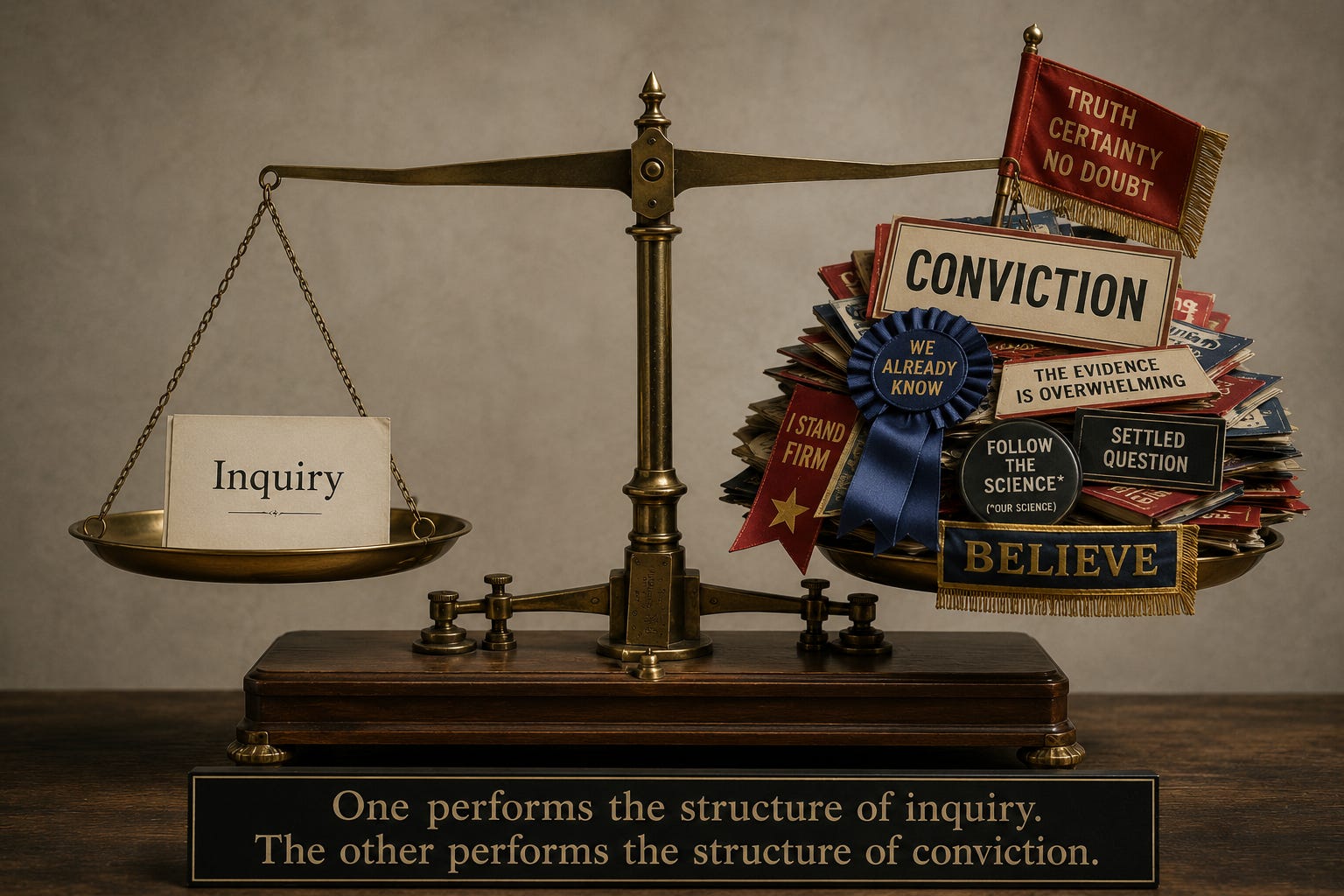
On the dimension you asked about, scientific bona fides and logic, the two pieces are not close. One performs the structure of inquiry; the other performs the structure of conviction.
What this exposes
Rogers has done real work in some areas, and the regression-cases concern that animates much of his writing deserves more serious investigation than institutional medicine has historically given it. Vaccine safety science should tolerate far more open inquiry than it often has. Public-health institutions damaged their own credibility profoundly during COVID through censorship impulses, exaggerated certainty, politicized modeling, and repeated unwillingness to acknowledge uncertainty honestly. None of that is in dispute.
What is in dispute is whether the response to that institutional failure should be a mirror-image dogmatism that imports its own destination, curates evidence to support it, and treats methodological skepticism as betrayal when applied to favored conclusions. The Claude analysis identifies precisely this structure in Rogers’s piece, and identifies the same vulnerability (in a smaller form) in mine. The latter point matters more than the former. A piece that survived external scrutiny only by being judged against a worse piece would not deserve the survival. The trendlines-in-lockstep critique stings because it is correct.
The deeper question is what happens to dissident science when it begins picking teams. The COVID period produced a generation of writers who learned, with good reason, to distrust institutional authority. That distrust was earned. But distrust is not a method, and the substitution of one orthodoxy for another is not a correction of the original failure, it is a reproduction of it in mirror image. Once every disagreement becomes evidence of corruption and every complexity becomes evidence of concealment, scientific reasoning itself begins deteriorating into political theology. The vocabulary of “transitional justice” -- a phrase belonging properly to post-authoritarian tribunals, war-crimes proceedings, and truth commissions -- has no business in a still-open empirical question. Its presence is the tell that the question has already been answered for the author before the analysis begins.

Autism almost certainly does not represent a single phenomenon with a single explanation. Genetics, environment, diagnostic expansion, institutional incentives, educational classifications, service availability, and ascertainment practices all play roles whose proportions remain genuinely uncertain — and that uncertainty is the honest position, not a failure of nerve. The proportions remain uncertain. That uncertainty is not weakness; it is intellectual honesty. The deeper obligation of science is not loyalty to tribes, institutions, pharmaceutical companies, dissident influencers, or ideological camps. It is the disciplined effort to distinguish categories carefully, define terms honestly, weigh evidence proportionally, and remain willing to follow data even when the destination proves uncomfortable -- including when the discomfort is one’s own.
Very interesting. I am always thinking of my own field, though, and really hope that Claude doesn't replace juries. Or judges and lawyers. My only comment on autism in general is whether we have any valid, current research data at this point, given the recent exposure of so much fraud. It’s a side thought but a real basis question for me. I’m familiar with the joke called data collection regarding the homeless in Los Angeles. It makes me highly skeptical of all funded programs. But thank you for this very informative piece.
With regards to genetics, I have to wonder how as a species we progressed to our situation today. I would have thought that autism would have been literally wiped out because the gene carrier wouldn't have survived to adult hood in the majority of our past. The environmental impact bears a larger responsibility then genetics, just as in most of our current chronic conditions.