Toby Or Not Toby
That Is The (Autism-) Question

To Sleep, Perchance To Dream; Ay, There’s The Rub
In last night’s dream, I was striding alongside (alma mater) Yale’s Cross Campus greensward. A darkly well-dressed academic (in bowler hat), flanked by an entourage, moved slowly ahead, occupying the entire sidewalk’s width deep in conversation. I overheard some departmental chatter. Not wanting to step on the grass, I lingered patiently behind. At a crosswalk, I attempted a quick slide-by, shoulder-turn pass. The professor bluntly pushed me back: wait, obey. Later, in the same dream, this natty prof. (at a party) demanded the students rise up, yell, demonstrate: the flipside of his previous emphasis on order. The “standards” were conditional and convenient: his getting what he wants, when he wants it.

Immediately upon awakening, I self-psychoanalyzed the scene as indicative of recent criticism from an authoritative figure (whom I admire, thus its sting): specifically that my delineation of Toby Rogers’ conception of the autism epidemic is absent of factual reasoning– with the intimation I am constructing a straw man (argument) out of personal animus (alone).
The accusation (on the heels of my recent interview by podcaster Tom Nelson and this Substack transcript of it) was that I had misquoted Rogers and miscast his theories, mindset and intentions.
“Toby nowhere EVER said that all autism is caused by vaccines. He never would say that because there is no way to know that!”
Nothing Is Either Good Or Bad, But Thinking Makes It So
That claim does not hold up against the record. Toby Rogers’ public statements frame vaccines and toxicants as the primary (essentially exclusive) driver of the autism epidemic.
In his September 9, 2025 Senate testimony he said: “the autism and chronic disease epidemics are primarily caused by toxicants -- mostly from vaccines and about a dozen additional toxicants.”
On Substack he has written: “We know what’s causing the autism epidemic. The bloated, unscientific, profit-driven CDC vaccine schedules are causing the autism epidemic,” and
“Autism appears mostly to be a story of iatrogenic injury from vaccines.”
He acknowledges some genetic background but treats it as secondary and de-emphasizes it (e.g., dismissing billions spent on genetic research as a dead end because “genes don’t suddenly create epidemics”)
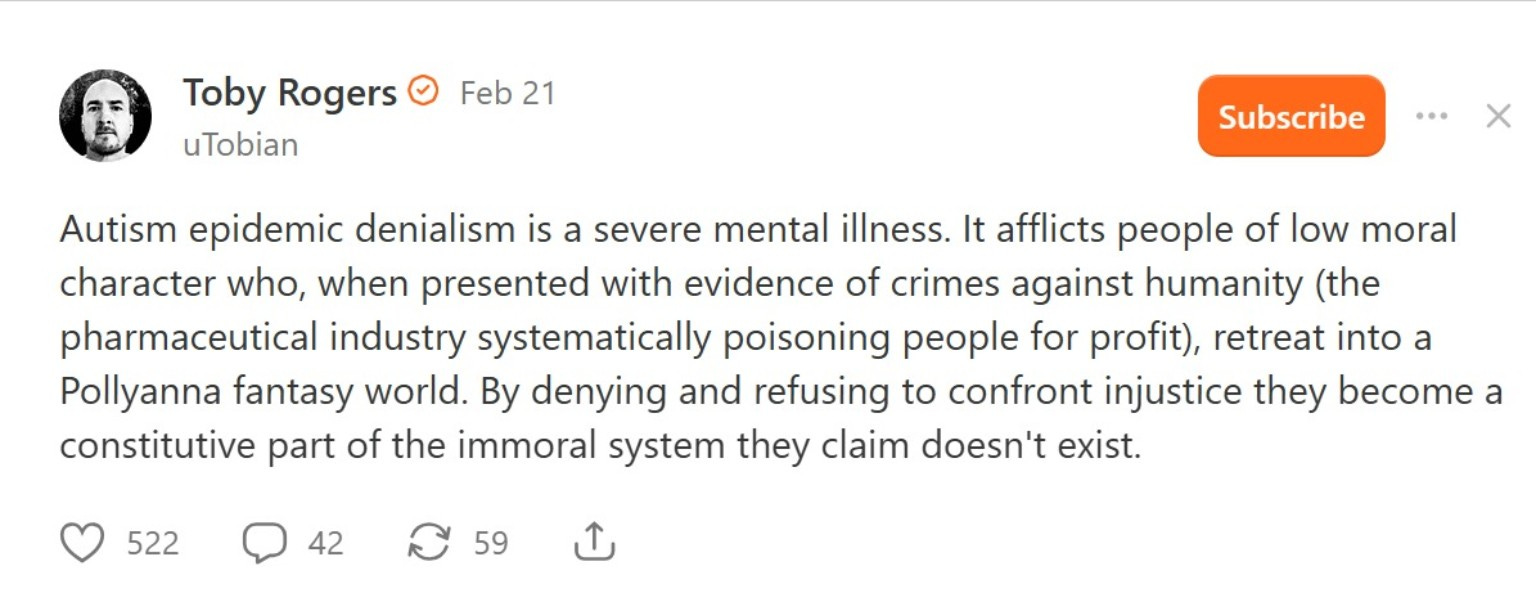
If vaccines are the primary driver of a population-level shift of this magnitude, then alternative explanations must be addressed directly and ruled out with equal rigor. In place of that evidentiary work, dissent is recast as heresy. Rogers labels refusal to accept this link “autism epidemic denialism,” describing it as a “severe mental illness” afflicting people of “low moral character” who retreat into a “Pollyanna fantasy world” rather than confront what he characterizes as “crimes against humanity” by the pharmaceutical industry.
Is that science? Science is not a person, and it does not require allegiance. Science proceeds by confronting competing explanations, not the explanations’ competitors. Rogers’ MPP/PhD training in public policy yields a toolkit of boundary-drawing, and moral framing. When disagreement is recast as defect, the analytic work stops. The question is no longer which explanation best fits the data, but which position one is permitted to hold.
One May Smile, And Smile, And Be A Villain
This pattern is not limited to the autism discussion. In a separate public comment, Toby wrote:
“Here’s the thing about all those Super Bowl ads that were not funny and did not make sense ... they were likely funded, written, and approved by people who received Covid shots and are now neurologically impaired.”
That statement begins with a subjective reaction to widely viewed advertisements and then attributes that reaction to neurological impairment from vaccination. It moves from personal aesthetic judgment to a generalized medical conclusion. Given the scale of global vaccination, this is an absurdly speculative assertion, once again illustrating Rogers’ tendency to convert disagreement or difference in perception into pathology or pejorative (see below).
Though This Be Madness, Yet There Is Method In’t
In the autism literature, large changes in measured prevalence require careful attention to diagnostic criteria, category expansion, and substitution effects.
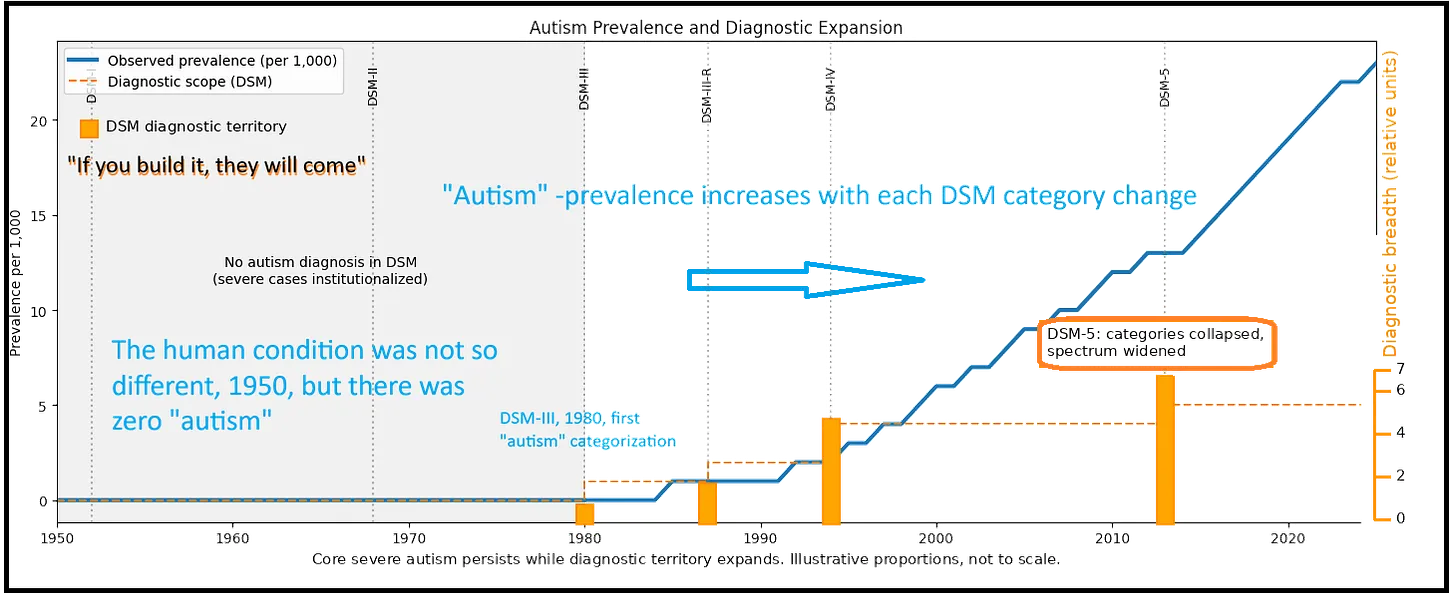
Administrative data over time show a substantial decline in intellectual disability classifications alongside a rise in autism diagnoses, which suggests reclassification plays a meaningful role, as Cremieux often notes.
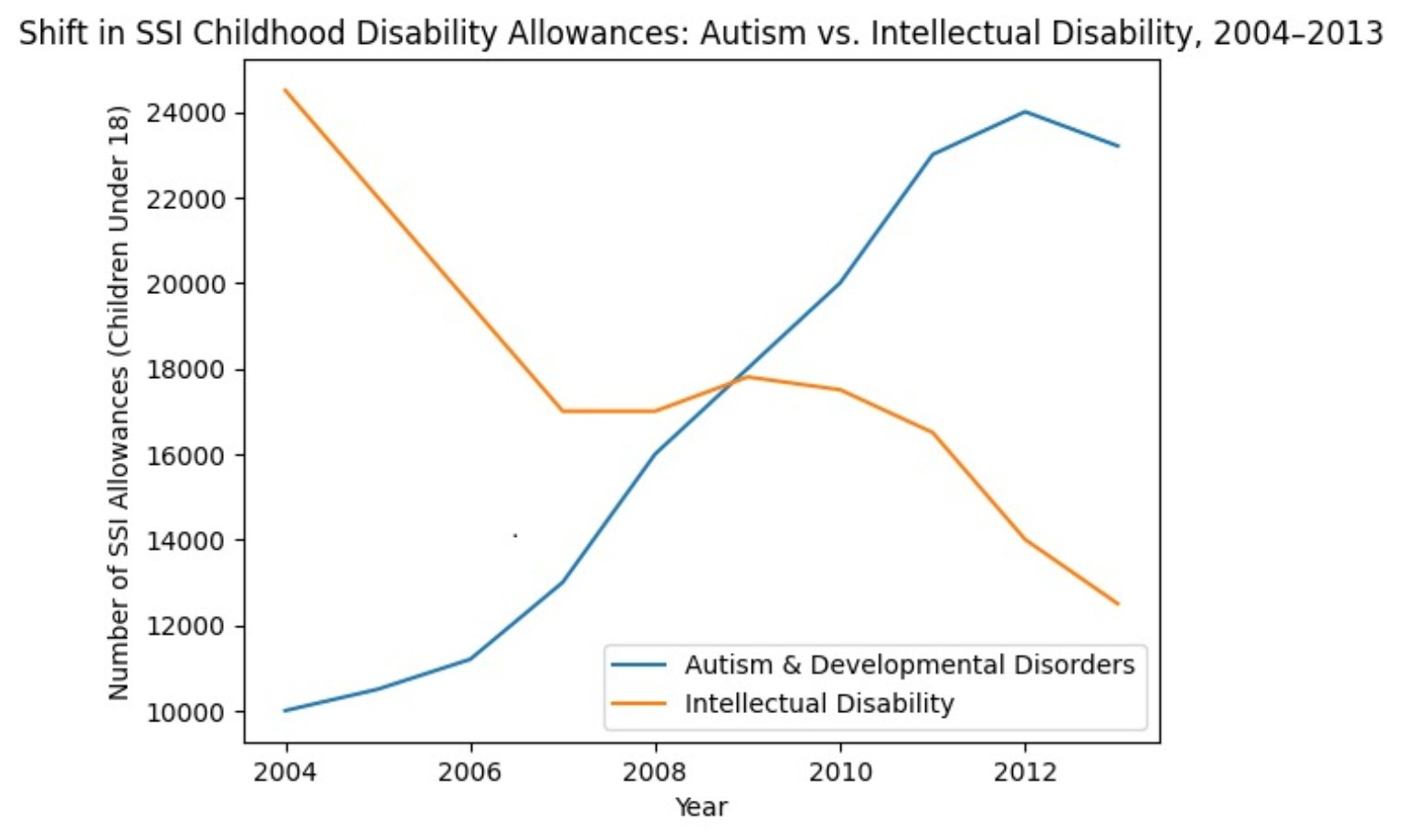
That pattern does not exclude other contributing factors, but it does require that definitional and institutional changes be accounted for before assigning a dominant causal mechanism. My concern is directed at that analytical step. When a strong causal narrative is advanced while dissent is treated as moral failure, those distinctions tend to collapse.
Toby Rogers was defended (in that accusation) as a “powerless poor researcher”; in tandem with my critique’s having “fanatically focused on harming” him. That characterization does not match reality. Toby has 100,000+ followers on X, comparable reach on Substack, Brownstone Institute fellowship status, and publicly calls for a $2-trillion reparations fund. In actuality, “powerless poor researcher” more aptly applies to me.
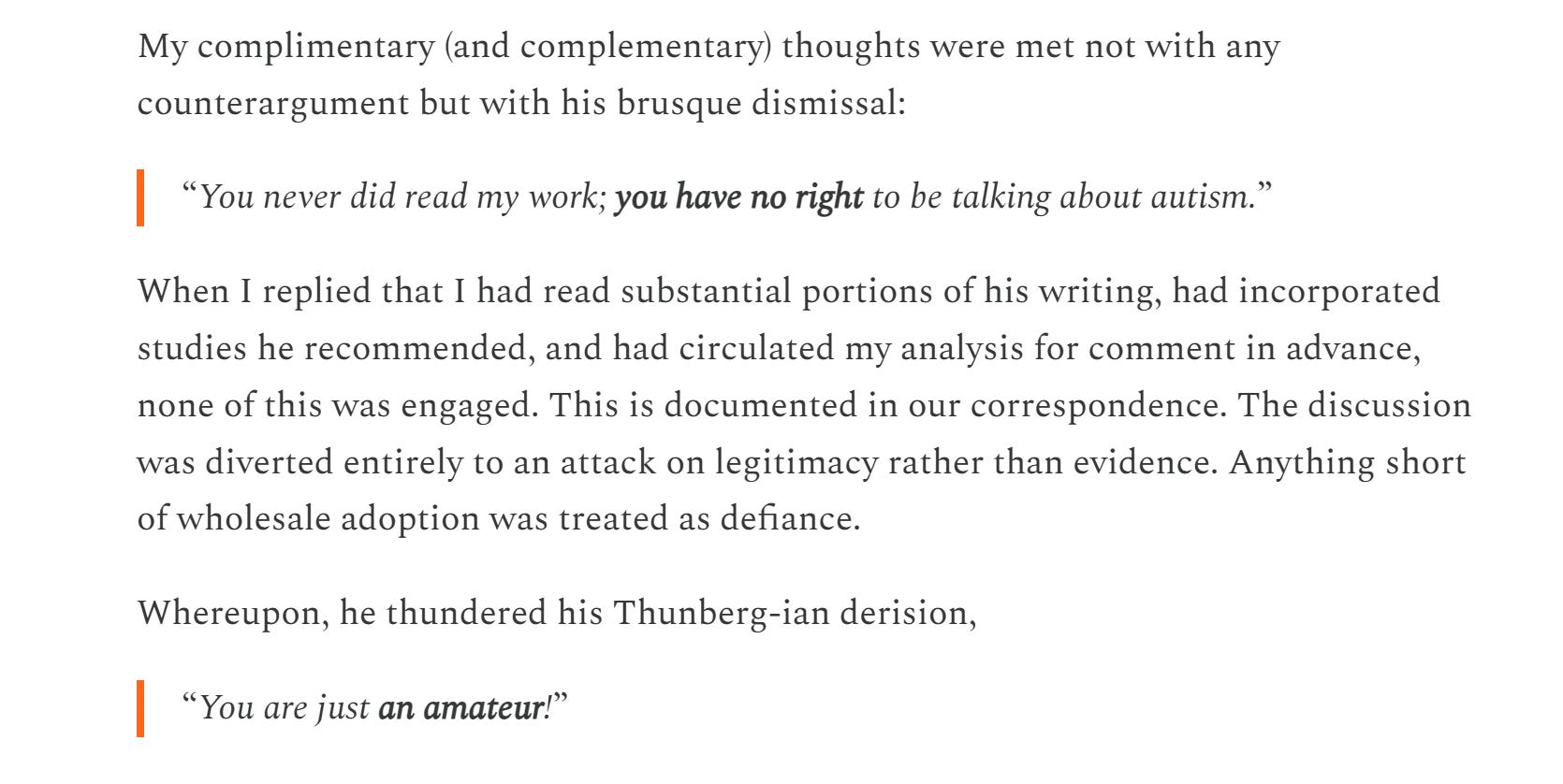
Prior to October 31, 2025 I had respected Rogers, engaged him in conversation while incorporating his comments on my preprint of Unraveling Autism’s Surge, to which he had sharing rights. That changed when Rogers (conversely, had) “focused on harming” me quasi-publicly (in triumvirate conversation with Bret Weinstein).
To his credit, scientist and physician Dr. Robert Malone accepted this (amateur’s) work, republishing the piece on June 11, 2025; deeming it
“an excellent job of making the vast array of information available on autism comprehensible,” and called it “essential reading... and ... a treatise, if you like, on the enigma scientists have labeled autism.”
Just prior, Brownstone had refused. Reasonable people can differ in editorial taste, of course, but the contrast matters. Had I suddenly abandoned rigor or wandered beyond my competence? Perhaps it did not fit the preferred framing of a fraught topic.
Give Every Man Thy Ear, But Few Thy Voice
Brownstone has presented itself as a place willing to follow inquiry where it leads, especially when subjects are politically sensitive. When a contributor’s work is welcomed across multiple topics and then effectively sidelined when he introduces a careful but unwelcome line of analysis on autism, the tension is not imaginary. It reflects an editorial choice about which forms of dissent remain acceptable and which do not.
There is also a policy dimension here that should not be waved away. Public calls for large-scale liability or reparations have far-reaching consequences for the pharmaceutical sector and for public health infrastructure.
“We need to set aside a trillion dollars to compensate autism families who’ve been injured by the childhood vaccine schedule. And we need to set aside a trillion dollars to compensate people... hurt by COVID-19 vaccines. That is foundational... to this country rebuilding and becoming a democracy again. We need to have a conversation about transitional justice.”
“Transitional justice” is associated with regime rupture. Rogers urges discontinuity from existing constitutional order rather than accountability within it.
Proposals of that magnitude warrant especially careful scrutiny of the underlying causal claims and evidentiary standards before they are treated as settled.
The Play’s The Thing Wherein I’ll Catch The Conscience Of The King
I would welcome a response from Toby Rogers that engages these points directly. I would welcome an open debate. Unfortunately I can’t include anything similar to Steve Kirsch’s $100,000 enticement (to Jake Scott, MD

If the causal claims hold, they should be able to withstand examination alongside competing explanations. If they do not, the rhetoric surrounding them should not substitute for evidence. The standard is simple. Define terms carefully. Examine the data. Distinguish classification from incidence. Separate assertion from proof.
The sidewalk is wide enough, if people make room. Until then, we must either line up behind this:
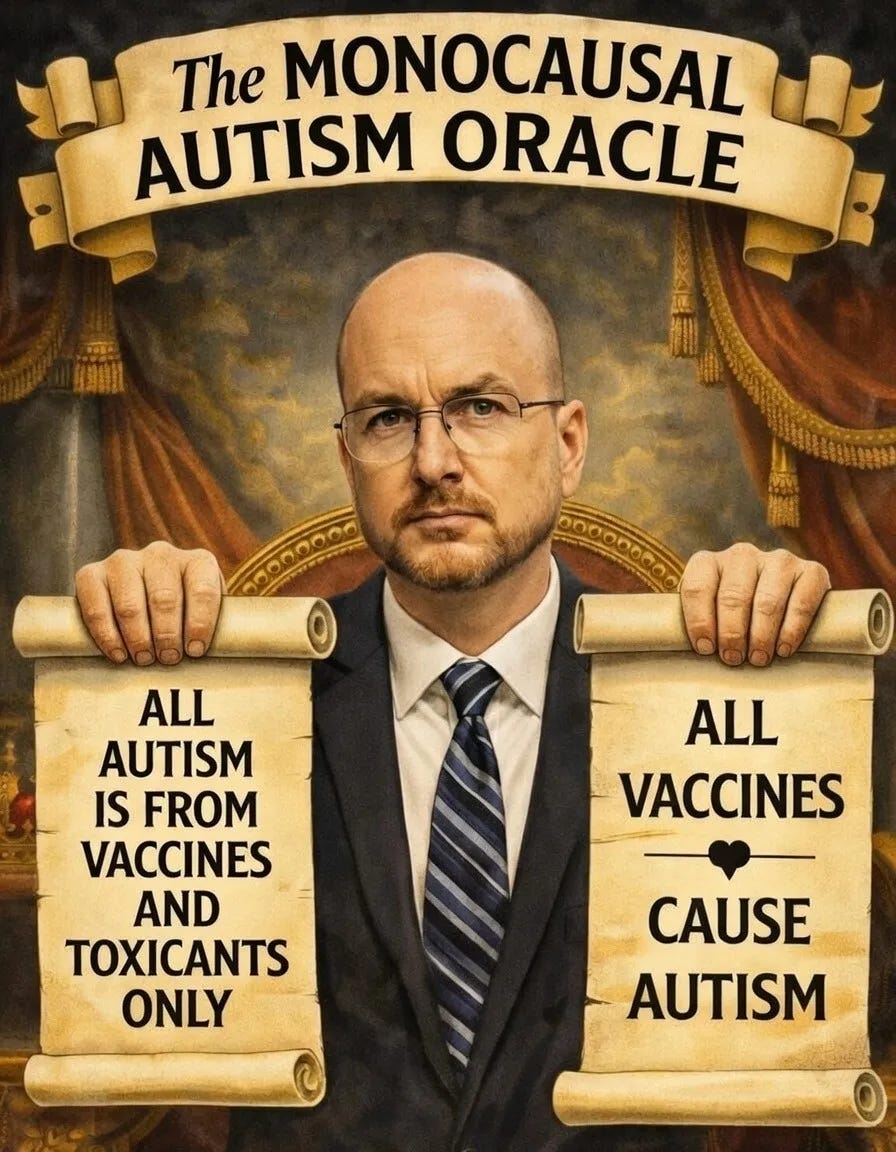
... or (preferably) pass it by
Here is an article I wrote about this topic: https://www.maybeitsmercury.com/the-great-poisoning. I think Toby Rogers is right. I just did a video short on this very topic: https://substack.com/home/post/p-191817429. (The written intro to this piece is my tech person overdoing AI and I don't have quite enough "spoons" to deal with it as yet.)
The neo-colonialist looters have been poisoning us with mercury for 150 years. I suppose they didn't start out doing it on purpose, but it is so hard to detect, and so profitable for the pharma/medical BLOB that it continues apace.